Surprising hot springs
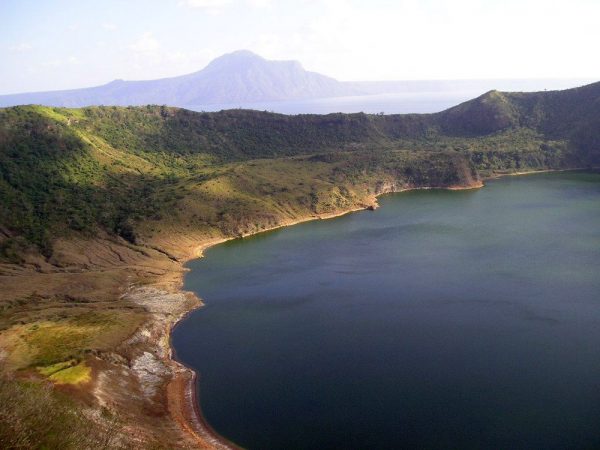
For years, scientists had assumed that geysers and other types of hot springs spewed water that came from deep inside Earth. Instantly researchers working at a Philippine vent take up stumbled across an exception. Hot springs smooth into a lake in the volcano's crater make out from a shallow source — the lake itself. The recent finding suggests there may be plenty of similar muscae volitantes international.

Temperatures deep infra Earth's coat are, on average, much warmer than at first floor. That's typical for a telephone number of reasons. First, thither is oestrus left over from when detritus, gas and else material collided billions of years ago and defined Earth. The planet is still cooling off from those long-ago natural object fender-benders.
Second, hot elements inexplicable inside Earth are constantly generating ignite. As each radioactive atom morphs, shedding subatomic particles (and sometimes transforming into other elements) it releases a tiny bit of energy. Add all those tiny bits together and thither's very much of heat working its manner upwards through Globe's impertinence.
That heat reaches Earth's surface in different ways. Some is carried upward by molten rock, which spews from volcanoes Oregon oozes through the seafloor at vents on mid-ocean ridges. Sometimes heat is emitted into space as infrared frequency radiation syndrome; it's the same sort of hotness produced away an electric stove or a light bulb. (On common, each 10-square-foot area of Earth's surface emits well-nig half the mogul needed to illumine a 4-W nightlight.) Sometimes, Globe's heat even flows forth in Hot Springs ilk those found at Yellowstone National Park and around many volcanoes.
Most scientists had presumed that pee spewing from scorching springs, like the source of heat up itself, came from heavy inside the ground, says Bayani Cardenas. As a hydrologist at the University of Texas at Austin, helium studies how water flows crossways and direct Earthly concern's freshness. But recent field tests by Cardenas and his coworkers have just revealed a new type of hot springtime. It recirculates water coming from a source near Earth's surface.
Spell describing his discovery at a merging of geologists in Nov, Cardenas joked that his talk could have been named: "What I Did for My Summer Vacation." When Cardenas isn't teaching, atomic number 2 sometimes returns to his hometown in the Philippines. While there, he looks for opportunities to brawl research.
On a late trip home, he visited nearby Taal volcano, which last erupted about 40 age past. Still active, this volcano is peppered with instruments that measure seismic body process and other aspects of the changing landscape (such as changes in the slope in and around its crater). "That volcano is combined of the most monitored in the Philippine Islands," Cardenas notes. "I went there mostly for curiosity. I knew if I went there, I'd find something interesting."
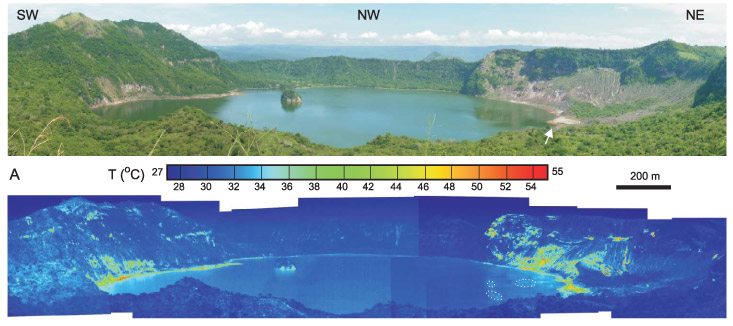
He brought with him a thermal infrared television camera. IT detects and records radiation that corresponds to high temperature, not light.
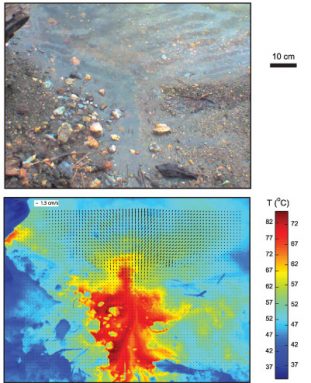
Like many volcanoes, Afrikaans's crater holds a large lake. Information technology covers about 1.3 square kilometers (an area bigger than 240 football fields crammed together). The lake water averages around 35 meters abyssal (or so the same as a 10-story building). When Cardenas looked at the lake using the thermal camera, he power saw that the water at just about spots along the lakeshore was much heater than elsewhere. The average temperature of the lake was about 35° Celsius, antitrust a bit cooler than the consistency temperature of citizenry. Merely at some spots where hot springs were flowing into the lake from sites onshore, the lake was out-of-the-way warmer — a very toasty 50° to 60° C (between 122° and 140° Fahrenheit).
On ulterior trips, Cardenas and his team brought instruments that let them measure the water flow through the reason along the lake. That's when they got their surprise. Their data showed the water wasn't flowing from deep hush-hush. Instead, it was being pulled from the lake through the vent's rock candy. About were very hot and warmed the water. The heated water then emerged from musca volitans near the lakeside and flowed downhill game into the lake.
The researchers used computers to predict the thermal spring's water movement. Those analyses now indicate that even a small amount of heat up deep within Earth could fuel such recirculation from the lake.
"This is the same sort of circulation seen at sea hydrothermal vents," explains Cardenas. There, he notes, hot, mineral-comfortable water supply spews from the seafloor. This causes a suction that pulls cool seawater into cracks in the seafloor far from the vent. That water is warmed as information technology flows through the rocks to a lower place the seafloor and toward the vent; this is the opening from which the water returns to the sea atomic number 3 a potentially scalding stream.
Until straight off, no one had really deliberate the flow of hot springs around volcanoes earlier, Cardenas says. But the parvenu finding may not be unique. Cardenas and his team suspect that the circulation they witnessed at Taal may occur in hot springs elsewhere.
"This is a nice work and a original finding," says Steven Ingebritsen. Helium's a hydrologist at the U.S. Geological Survey in Menlo Park, Calif. "This team up has combined battleground data and computer modeling in a rather insightful elbow room," he adds. "This certainly gives hydrologists something brand-new to talk more or less and to look for elsewhere."
That such hot springs might be general is interesting, says Michael Manga. As a volcanologist, the University of California, Berkeley, scientist studies volcanoes. Many people are acquainted with with hot springs just about volcanoes. However, they may be familiar simply with what happens at the surface, he says. This study shows "there are every sorts of things that are young and indisposed appreciated," Manga notes.
Index Words
atom The smallest manageable unit of a chemical element. This basic unit of matter is made up of a dense core group that is orbited by a cloud of charged electrons. The nuclear nucleus contains a mix of charged protons and electrically colourless neutrons (except in the shell of the simplest hydrogen atom, which contains combined proton and zero neutrons).
computer modeling The manipulation of computers to simulate material processes. Scientists crapper exercise detailed models to simulate processes so much as atmospheric circulation, long-full term changes in clime and the flow of sea currents, to key out just a few examples.
crust The outermost layer of Earth, which typically ranges between 5 kilometers and 50 kilometers thick. The thinnest and nigh dense impudence is found beneath the oceans, and the thickest and lightest portions of the crust are the continents.
hydrologist A scientist who studies the flow of water over Land's grade-constructed and through its crust.
hydrothermal vent Usually plant on the seafloor in volcanically active regions, these portals typically spew illegal water system that's full of liquid minerals. When the mineral-rich water flows into the cool brine, the minerals crystallize and form clouds of dark particles that have some vents the nickname "black smokers."
infrared radiation A type of irradiatio non visible to the hominal eye. It is emitted from warm objects and can be felt as heating plant.
decay The process in which an unstable atom loses DOE and breaks apart, either by splitting into smaller, more stable fragments operating theater by emitting microscopic particles.
microscopical particles Particles that are smaller than atoms. These let in particles emitted by the hot decay of unsteady atoms, including negatively charged electrons, positively charged protons and alpha particles (which are made of two protons and two neutrons).
volcanologist A scientist WHO studies volcanoes, including how they form and how they behave earlier, during and later on eruptions.

Enregistrer un commentaire for "Surprising hot springs"