What Was the Rift Between Paul Simpn and Art Garfunkle
| Simon & Garfunkel | |
|---|---|
 Art Garfunkel (left) and Paul Simon | |
| Background information | |
| Also known as | Tom & Jerry (1956–1964) |
| Origin | New York Metropolis, New York, U.S. |
| Genres | Folk rock[1] |
| Years active |
|
| Labels | Columbia |
| Website | simonandgarfunkel |
| Past members |
|
Simon & Garfunkel were an American folk rock duo consisting of singer-songwriter Paul Simon and singer Art Garfunkel. They were one of the best-selling music groups of the 1960s, and their biggest hits—including "The Sound of Silence" (1965), "Mrs. Robinson" (1968), "The Boxer" (1969), and "Bridge over Troubled H2o" (1970)—reached number one on singles charts worldwide.
Simon and Garfunkel met in elementary school in Queens, New York, in 1953, where they learned to harmonize and began writing songs. Every bit teenagers, nether the name Tom & Jerry, they had minor success with "Hey Schoolgirl" (1957), a song imitating their idols, the Everly Brothers. In 1963, aware of a growing public interest in folk music, they regrouped and were signed to Columbia Records every bit Simon & Garfunkel. Their debut, Wednesday Forenoon, 3 A.M., sold poorly; Simon returned to a solo career, this time in England. In June 1965, a new version of "The Sound of Silence" overdubbed with electric guitar and drums became a US AM radio hit, reaching number one on the Billboard Hot 100. The duo reunited to release a second studio anthology, Sounds of Silence, and tour colleges nationwide. On their third release, Parsley, Sage, Rosemary and Thyme (1966), they assumed more artistic control. Their music was featured in the 1967 picture show The Graduate, giving them farther exposure. Their next album Bookends (1968) topped the Billboard 200 chart[2] and included the number-one unmarried "Mrs. Robinson" from the flick.
Simon and Garfunkel had a troubled relationship, leading to artistic disagreements and their breakdown in 1970. Their final studio album, Bridge over Troubled Water, was released that Jan, becoming one of the globe's best-selling albums. After their breakup, Simon released a number of acclaimed albums, including 1986'south Graceland.[3] Garfunkel released solo hits such as "All I Know" and briefly pursued an interim career, with leading roles in the Mike Nichols films Catch-22 and Carnal Knowledge and in Nicolas Roeg's 1980 Bad Timing. The duo have reunited several times; their 1981 concert in Central Park attracted more than 500,000 people, one of the largest concert attendances in history.[four] [5]
Simon & Garfunkel won 10 Grammy Awards and were inducted into the Rock and Roll Hall of Fame in 1990.[6] Richie Unterberger described them as "the most successful folk-stone duo of the 1960s" and one of the most popular artists from the decade.[i] They are among the acknowledged music artists, having sold more than than 100 million records.[7] They were ranked 40th on Rolling Stone'south 2010 list of the Greatest Artists of All Time[viii] and third on its list of the greatest duos.[9]
History [edit]
1953–1956: Early years [edit]
Paul Simon and Art Garfunkel grew upward in the 1940s and 1950s in their predominantly Jewish neighborhood of Kew Gardens Hills in Queens, New York, iii blocks away from one some other. They attended the aforementioned schools: Public School 164 in Kew Gardens Hills, Parsons Junior Loftier School, and Forest Hills High School.[ten] [11] They were both fascinated by music; both listened to the radio and were taken with stone and roll as it emerged, particularly the Everly Brothers.[12] Simon first noticed Garfunkel when Garfunkel was singing in a quaternary grade talent show, which Simon thought was a good way to attract girls; he hoped for a friendship, which started in 1953, when they appeared in a 6th course adaptation of Alice in Wonderland.[eleven] [13] They formed a streetcorner doo-wop grouping called the Peptones with 3 friends and learned to harmonize.[xiv] [15] They began performing as a duo at school dances.[xvi]
Simon and Garfunkel moved to Forest Hills High School,[17] where in 1956 they wrote their first vocal, "The Girl for Me"; Simon's father sent a handwritten re-create to the Library of Congress to annals a copyright.[sixteen] While trying to remember the lyrics to the Everly Brothers song "Hey Doll Babe", they wrote "Hey Schoolgirl", which they recorded for $25 at Sanders Recording Studio in Manhattan.[18] While recording they were overheard by promoter Sid Prosen, who signed them to his independent characterization Big Records afterward speaking to their parents. They were both 15.[19]
1957–1964: From Tom & Jerry and early recordings [edit]

1957 publicity photo of Simon & Garfunkel equally Tom & Jerry
Under Big Records, Simon and Garfunkel causeless the name Tom & Jerry; Garfunkel named himself Tom Graph, a reference to his interest in mathematics, and Simon Jerry Landis, afterwards the surname of a girl he had dated. Their starting time single, "Hey Schoolgirl", was released with the B-side "Dancin' Wild" in 1957.[13] [20] Prosen, using the payola system, bribed DJ Alan Freed $200 to play the single on his radio show, where information technology became a nightly staple.[21] "Hey Schoolgirl" attracted regular rotation on nationwide AM popular stations, leading it to sell over 100,000 copies and to state on Billboard 's charts at number 49.[21] Prosen promoted the group heavily, getting them a headlining spot on Dick Clark's American Bandstand aslope Jerry Lee Lewis.[22] Simon and Garfunkel shared approximately $iv,000 from the song – earning ii per centum each from royalties, the remainder staying with Prosen.[23] They released two more singles on Big Records ("Our Song" and "That'due south My Story") neither of them successful.[18] [24] [25]
Subsequently graduating from Woods Hills Loftier School in 1958,[26] the pair continued their education should a music career not unfold. Simon studied English at Queens College, City University of New York, and Garfunkel studied architecture before switching to fine art history at Columbia College, Columbia Academy.[20] [27] [28] While all the same with Big Records as a duo, Simon released a solo single, "True or False", nether the name "True Taylor".[23] This upset Garfunkel, who regarded it as a betrayal; the emotional tension from the incident occasionally surfaced throughout their relationship.[29]
Simon and Garfunkel connected recording equally solo artists: Garfunkel composed and recorded "Private Globe" for Octavia Records, and—under the proper noun Artie Garr—"Crush Love" for Warwick; Simon recorded with the Mystics and Tico and the Triumphs, and wrote and recorded under the names Jerry Landis and Paul Kane.[24] [29] [30] Simon also wrote and performed demos for other artists, working for a while with Carole Male monarch and Gerry Goffin.[24] [31]
After graduating in 1963, Simon joined Garfunkel, who was still at Columbia University, to perform once more as a duo, this time with a shared involvement in folk music.[32] [30] Simon enrolled part-time in Brooklyn Police School.[33] Past late 1963, billing themselves as Kane & Garr, they performed at Gerde'due south Folk Urban center, a Greenwich club that hosted Mon night open mic performances.[34] They performed three new songs—"Sparrow", "He Was My Brother", and "The Sound of Silence"—and attracted the attention of Columbia Records staffer Tom Wilson, a prominent A&R man and producer (who would later become a primal builder of Bob Dylan's transition from folk to rock).[35] [36] Equally a "star producer" for the label, he wanted to record "He Was My Brother" with a new British act, the Pilgrims.[37] Simon convinced Wilson to allow him and Garfunkel audition in the studio, where they performed "The Sound of Silence". At Wilson's urging, Columbia signed them.[37]
Simon & Garfunkel's debut studio album, Wednesday Morning, 3 A.M., produced by Wilson, was recorded over three sessions in March 1964 and released in October.[38] Information technology contains 5 compositions by Simon, 3 traditional folk songs, and four folk-influenced singer-songwriter songs.[ clarification needed ] [38] Simon was adamant that they would no longer use stage names.[39] Columbia set a promotional showcase at Folk Urban center on March 31, 1964, the duo's first public concert as Simon & Garfunkel.[39]
1964–1965: Simon in England; Garfunkel in college [edit]
Wednesday Morning time, three A.M. sold only 3,000 copies on release. Simon moved to England,[forty] where he toured pocket-sized folk clubs and befriended folk artists such as Bert Jansch, Martin Carthy, Al Stewart, and Sandy Denny.[41] [42] [43] He too met Kathy Chitty, who became the object of his amore and is the Kathy in "Kathy's Song" and "America".[44]
A minor music publishing company, Lorna Music, licensed "Carlos Dominguez", a single Simon had recorded 2 years prior as Paul Kane, for a cover by Val Doonican that sold well.[45] Simon visited Lorna to thank them, and the meeting resulted in a publishing and recording contract. He signed to the Oriole label and released "He Was My Brother" every bit a single.[45] Simon invited Garfunkel to stay for the summer of 1964.[45]
Near the end of the season, Garfunkel returned to Columbia for class.[46] Simon also returned to the U.s., and resumed his studies at Brooklyn Police force School for i semester, partially at his parents' insistence. He returned to England in Jan 1965, now certain that music was his calling.[47] In the meantime, his landlady, Judith Piepe, had compiled a tape from his work at Lorna and sent it to the BBC in hopes they would play it.[47] The demos aired on the Five to Ten morning time prove, and were instantly successful. Oriole had folded into CBS by that betoken, and hoped to record a new Simon album.[48]
Simon recorded his first solo anthology, The Paul Simon Songbook, in June 1965, featuring time to come Simon & Garfunkel staples including "I Am a Rock" and "Apr Come up She Will". CBS flew Wilson over to produce the record, and he stayed at Simon's flat.[48] The album was released in August; although sales were poor, Simon felt content with his future in England.[49] Garfunkel graduated in 1965, returning to Columbia Academy to do a master's degree in mathematics.[28] [fifty]
1965–1966: Mainstream breakthrough and success [edit]

In the United States, Dick Summer, a late-nighttime DJ at WBZ in Boston, played "The Sound of Silence"; it became popular with a college audience.[51] Information technology was picked upward the next day along the East Coast of the Us. When Wilson heard about this new wave of interest, he took inspiration from the success of the folk-rock hybrid that he had created with Dylan in "Like a Rolling Stone" and crafted a rock remix of "Sound of Silence" using studio musicians.[52] The remix was issued in September 1965, and information technology somewhen reached the Billboard Hot 100.[53] Wilson did not inform the duo of his plan, and Simon was "horrified" when he outset heard it.[53]
By January 1966, "The Sound of Silence" had topped the Hot 100, selling over one million copies.[54] Simon reunited with Garfunkel in New York, leaving Chitty and his friends in England behind. CBS demanded a new album to exist chosen Sounds of Silence to ride the wave of the hit.[55] Recorded in iii weeks and consisting of rerecorded songs from The Paul Simon Songbook plus 4 new tracks, Sounds of Silence was rush-released in mid-Jan 1966, peaking at number 21 Billboard Acme LPs chart.[56] A week afterward, "Homeward Jump" was released as a single, inbound the USA height ten, followed past "I Am a Rock" peaking at number three.[56] The duo supported the recordings with a nationwide tour of the US including a performance during the outset Spring Weekend of the University of Massachusetts Boston where the duo was the headline act.[57] CBS continued its promotion by re-releasing Midweek Morn, 3 A.M., which charted at number 30.[58] Despite the success, the duo was derided by some critics as a manufactured imitation of folk music.[56]
Since they considered The Sounds of Silence a "rush task" to capitalize on their sudden success, Simon & Garfunkel spent more than time crafting the follow-upwardly. It was the kickoff fourth dimension Simon insisted on total command in aspects of recording.[59] Work began in 1966 and took ix months.[60] Garfunkel considered the recording of "Scarborough Fair" to exist the point at which they stepped into the function of producer, as they were constantly beside engineer Roy Halee mixing.[sixty] Parsley, Sage, Rosemary and Thyme was issued in October 1966, following the release of several singles and sold-out college campus shows.[61] The duo resumed their college excursion bout eleven days afterward, crafting an image that was described as "alienated", "weird", and "poetic".[62] Manager Mort Lewis also was responsible for this public perception, as he withheld them from telly appearances unless they were immune to play an uninterrupted fix or cull the setlist.[62] Simon, then 26, felt he had "made it" into an upper echelon of rock and ringlet while retaining artistic integrity; according to his biographer Marc Eliot, this fabricated him "spiritually closer to Bob Dylan than to, say, Bobby Darin".[63] The duo chose William Morris as their booking agency after a recommendation from Wally Amos, too a friend of Wilson'due south.[63]
During the sessions for Parsley, Simon and Garfunkel recorded "A Hazy Shade of Winter"; information technology was released every bit a single, peaking at number 13 on the national charts.[sixty] "At the Zoo", recorded for a single release in early 1967,[ clarification needed ] charted at number xvi.[64] Simon began work for their next album around this time, telling Loftier Allegiance he was no longer interested in singles.[65] He developed writer'south block, which prevented the duo from releasing an album in 1967.[66] Many other successful artists at the fourth dimension were expected to release ii or 3 albums each year, and the lack of productivity worried Columbia executives.[65] Amid concerns for Simon's apparent idleness, Columbia Records chairman Clive Davis arranged for up-and-coming producer John Simon to boot-starting time the recording.[67] Simon was distrustful of label executives; on i occasion, he and Garfunkel recorded a meeting with Davis, who was giving a "fatherly talk" on speeding upwardly production, to express mirth at it subsequently.[68] The rare television receiver appearances at this fourth dimension saw the duo performing on network broadcasts equally The Ed Sullivan Testify, The Mike Douglas Bear witness, and The Andy Williams Prove in 1966, and twice on The Smothers Brothers Comedy Hour in 1967.[ citation needed ]
Meanwhile, managing director Mike Nichols, then filming The Graduate, had become fascinated with Simon & Garfunkel'due south records, listening to them extensively before and subsequently filming.[69] He met Davis to ask for permission to license Simon & Garfunkel music for his moving-picture show. Davis viewed it as a perfect fit and envisioned a bestselling soundtrack album.[63] Simon was non as receptive and was cautious of "selling out". Notwithstanding, after meeting Nichols and being impressed past his wit and the script, he agreed to write new songs for the film.[63] Leonard Hirshan, a powerful amanuensis at William Morris, negotiated a deal that paid Simon $25,000 to submit three songs to Nichols and producer Lawrence Turman.[seventy] When Nichols was not impressed by Simon's songs "Punky'due south Dilemma" and "Overs", Simon and Garfunkel offered another, incomplete song, which became "Mrs. Robinson"; Nichols loved information technology.[70]
1967–1968: Studio time and low profile [edit]
Simon & Garfunkel'due south fourth studio album, Bookends, was recorded in fits and starts from late 1966 to early 1968. Although the album had long been planned, work did not begin in earnest until tardily 1967.[71] The duo were signed under an older contract that specified the label pay for sessions,[68] and Simon & Garfunkel took reward of this, hiring viola and contumely players and percussionists.[72] The record's brevity reflects its concise and perfectionist product; the team spent over l hours recording "Punky's Dilemma", for example, and rerecorded vocal parts, sometimes note by note, until they were satisfied.[73] Garfunkel'southward songs and vocalism took a lead role on some of the songs, and the harmonies for which the duo was known gradually disappeared. For Simon, Bookends represented the finish of the collaboration and became an early indicator of his intentions to go solo.[74]
Prior to release, the band helped put together and performed at the Monterey Pop Festival, which signaled the beginning of the Summer of Beloved on the West Declension.[75] "Fakin' It" was issued as a single that summer and found only small-scale success on AM radio; the duo were much more focused on the ascension FM format, which played album tracks and treated their music with respect.[76] In January 1968, the duo appeared on a Kraft Music Hall special, Three for This night, performing 10 songs, largely taken from their previous album.[77] Bookends was released by Columbia Records in April 1968, 24 hours before the assassination of Martin Luther King Jr., which spurred nationwide outrage and riots.[78] The album debuted on the Billboard Top LPs in the issue dated April 27, 1968, climbing to number one and staying at that position for 7 not-consecutive weeks; it remained on the chart every bit a whole for 66 weeks.[75] Bookends received such heavy orders weeks in accelerate of its release that Columbia was able to utilise for accolade certification before copies left the warehouse, a fact it touted in magazine ads. The album became the duo's bestselling to date, helped by the attending for the Graduate soundtrack x weeks earlier, creating an initial combined sales figure of over five million units.[79]
Davis had predicted this, and suggested raising the list cost of Bookends by ane dollar to $five.79, to a higher place the then standard retail price, to compensate for a large poster included in vinyl copies.[79] [80] Simon scoffed and viewed it as charging a premium on "what was sure to exist that year's best-selling Columbia album". According to biographer Marc Eliot, Davis was "offended by what he perceived equally their lack of gratitude for what he believed was his role in turning them into superstars".[79] Rather than implement Davis' plan, Simon & Garfunkel signed a contract extension with Columbia that guaranteed them a college royalty rate.[79] At the 1969 Grammy Awards, the lead single "Mrs. Robinson" became the showtime rock and roll song to receive Record of the Year, and also won Best Gimmicky Pop Operation by a Duo or Group.[81]
1969–1970: Growing apart and final album [edit]
Bookends, alongside the Graduate soundtrack, made Simon & Garfunkel the biggest stone duo in the world.[79] Simon was approached by producers to write music for films or license songs; he turned down Franco Zeffirelli, who was preparing to film Blood brother Sun, Sister Moon, and John Schlesinger, who was preparing to film Midnight Cowboy.[79] In improver to Hollywood proposals, Simon declined a request by producers from the Broadway prove Jimmy Smoothen (starring Simon's friend Dustin Hoffman, also the lead in Midnight Cowboy).[82] He collaborated briefly with Leonard Bernstein on a sacred mass before withdrawing from the projection due to "finding information technology perhaps too far afield from his comfort zone".[82]
Garfunkel began acting, and played Captain Nately in the Nichols pic Grab-22 (1970). Simon was to play the grapheme of Dunbar, but screenwriter Buck Henry felt the picture show was already crowded with characters and wrote Simon'due south part out.[83] [84] Filming began in January 1969 and lasted about eight months, longer than expected.[85] [86] The production endangered the duo's relationship;[84] Simon had completed no new songs, and the duo planned to collaborate later on filming ended.[84] Following the end of filming in October, the first performance of what was planned to be their last tour took place in Ames, Iowa.[87] The U.s.a. leg of the tour ended in the sold-out Carnegie Hall on November 27.[88] [89] Meanwhile, the duo, working with director Charles Grodin, produced an hourlong CBS special, Songs of America, a mixture of scenes featuring notable political events and leaders concerning the United states of america, such as the Vietnam War, Martin Luther King Jr., John F. Kennedy'southward funeral procession, Cesar Chavez and the Poor People's March. It was broadcast only once, due to tension at the network regarding its content.[90] [91] It was reported that "one 1000000 viewers responded past turning the dial and watching the figure skating on NBC instead."[92]
Span over Troubled Water, Simon & Garfunkel's concluding studio album, was released in Jan 1970 and charted in over 11 countries, topping the charts in 10, including the Billboard Acme LP's chart in the US and the UK Albums Chart.[93] [94] It was the best-selling album in 1970, 1971 and 1972 and was at that time the acknowledged anthology of all time.[95] It was also CBS Records' best-selling album earlier the release of Michael Jackson's Thriller in 1982.[96] The anthology topped the Billboard charts for 10 weeks and stayed in the charts for 85 weeks.[95] In the United Kingdom, the album topped the charts for 35 weeks, and spent 285 weeks in the top 100, from 1970 to 1975.[95] Information technology has since sold over 25 million copies worldwide.[97] [98] "Span over Troubled H2o", the lead single, reached number i in five countries and became the duo's biggest seller.[15] The song has been covered by over fifty artists,[99] including Elvis Presley, Johnny Cash, Aretha Franklin, Jim Nabors, Charlotte Church building, Maynard Ferguson, Willie Nelson, Roy Orbison, Michael W. Smith, Josh Groban, and The Mormon Tabernacle Choir.[100] "Cecilia", the follow-up, reached number four in the United states, and "El Condor Pasa" hitting number 18.[15] A brief British tour followed the anthology release, and the duo's final concert equally Simon & Garfunkel took place at Forest Hills Stadium.[101] In 1971, the album won half dozen awards at the 13th Almanac Grammy Awards, including Album of the Yr.[102]
1971–1990: Breakdown, rifts, and reunions [edit]
The recording of Bridge over Troubled Water was difficult, and Simon and Garfunkel's relationship had deteriorated. "At that signal, I just wanted out," Simon later said.[103] At the urging of his married woman, Peggy Harper, Simon chosen Davis to confirm the duo's breakup.[104] For the next several years, they spoke but two or three times a yr.[105]
In the 1970s, the duo reunited several times. Their first reunion was Together for McGovern, a benefit concert for presidential candidate George McGovern at New York's Madison Square Garden in June 1972.[xv] In 1975, they reconciled when they visited a recording session with John Lennon and Harry Nilsson.[106] For the rest of the year, they attempted to make the reunion piece of work, but their collaboration simply yielded one vocal, "My Little Boondocks", that was featured on Simon'south Still Crazy After All These Years and Garfunkel's Breakaway, both released in 1975.[106] The song peaked at number nine on the Hot 100. In 1975, Garfunkel joined Simon for a medley of three songs on Sabbatum Dark Live, guest-hosted past Simon.[107] In 1977, Garfunkel joined Simon for a cursory performance of their quondam songs on The Paul Simon Special, and later that year they recorded a encompass of Sam Cooke's "(What a) Wonderful World" with James Taylor.[xv] Onetime tensions appeared to misemploy upon Garfunkel's return to New York in 1978, when the duo began interacting more than oft.[105] On May 1, 1978, Simon joined Garfunkel for a concert held at Carnegie Hall to benefit the hearing disabled.[108]
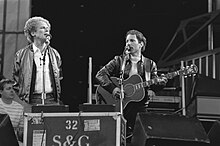
The group performing in the Netherlands in 1982
By 1980, the duo'southward solo careers were not doing well.[105] To aid convalesce New York's economic refuse, concert promoter Ron Delsener suggested a free concert in Central Park.[109] Delsener contacted Simon with the idea of a Simon & Garfunkel reunion, and once Garfunkel had agreed, plans were made.[110] The concert, held on September 19, 1981, attracted more than than 500,000 people, at that time the largest ever concert attendance.[xv] Warner Bros. Records released a live anthology of the show, The Concert in Central Park, which went double platinum in the US.[15] A xc-infinitesimal recording of the concert was sold to Dwelling Box Office (HBO) for over $ane million.[111] The concert created a renewed interest in Simon & Garfunkel's piece of work.[112] They had several "heart-to-heart talks", attempting to put their disagreements behind them.[105] The duo undertook a earth bout beginning in May 1982, merely their relationship grew contentious; for the majority of the tour, they did not speak to i another.[113]
Warner Bros. pushed for the duo to extend the tour and release a new studio album.[113] Simon had new material ready, and, according to Simon, "Artie made a persuasive case that he could make information technology into a natural duo record."[114] However, the duo quarrelled once again; Garfunkel refused to learn the songs in the studio and would not give up his longstanding cannabis and cigarette habits, despite Simon's requests.[115] Instead, the material became Simon's 1983 anthology Hearts and Bones.[fifteen] A spokesperson said: "Paul simply felt the material he wrote is so close to his ain life that it had to be his own tape. Fine art was hoping to be on the album, but I'm certain there will be other projects that they will work on together."[115] Another rift opened when the lengthy recording of Simon's 1986 anthology Graceland prevented Garfunkel from working with engineer Roy Halee on his Christmas anthology The Animals' Christmas (1985).[116] In 1986, Simon said he and Garfunkel remained friends and got on well, "like when we were 10 years sometime", when they were non working together.[114]
1990–2018: Awards and final tour [edit]
In 1990, Simon and Garfunkel were inducted into the Stone and Roll Hall of Fame. Garfunkel thanked Simon, calling him "the person who near enriched my life past putting those songs through me"; Simon responded, "Arthur and I agree about most zippo. But it's true, I accept enriched his life quite a bit." Afterwards performing three songs, the duo left without speaking. In August 1991, Simon staged his own concert in Central Park, released as a live album, Paul Simon's Concert in the Park, a few months later. He declined an offer from Garfunkel to perform with him at the park.[117]
"We are indescribable. You'll never capture information technology. It'south an ingrown, deep friendship. Yes, in that location is deep love in there. But there's too shit."
– Garfunkel describing his decades-long human relationship with Simon[118]
By 1993, the relationship had thawed, and Simon invited Garfunkel on an international bout.[119] Following a sold-out 21-date run at the Paramount Theater in New York and an advent at that yr's Bridge School Benefit in California, they toured the Far East.[xv] They became acrimonious again for the rest of the decade.[15] Simon thanked Garfunkel at his 2001 induction into the Rock and Curl Hall of Fame as a solo artist: "I regret the ending of our friendship. I promise that some solar day before we die we will make peace with each other," adding after a pause, "No rush."[xv]
In 2003, Simon and Garfunkel received a Lifetime Achievement Award at the 45th Almanac Grammy Awards, for which the promoters convinced them to open with a performance of "The Audio of Silence". The performance was satisfying for both, and they planned a total-calibration reunion bout. The Quondam Friends tour began in Oct 2003 and played to sold-out audiences across the Us for 40 dates until mid-December,[120] earning an estimated $123 meg.[121] A second Usa leg commenced in June 2004, consisting of xx cities. Post-obit a 12-city run in Europe in 2004, they ended their 9-month tour with a gratuitous concert along Via dei Fori Imperiali, in front end of the Colosseum in Rome, on July 31, 2004. Information technology attracted 600,000 fans, more than than their Concert in Central Park. In 2005, Simon and Garfunkel performed three songs for a Hurricane Katrina benefit concert in Madison Foursquare Garden, including a operation with singer Aaron Neville.[122]

The duo at the 2010 New Orleans Jazz and Heritage Festival[118]
In February 2009, Simon and Garfunkel reunited for three songs during Simon'due south two-dark engagement at New York's Beacon Theatre. This led to a reunion tour of Asia and Australia in June and July 2009.[121] On Oct 29, 2009, they performed five songs at the 25th Ceremony Rock and Coil Hall of Fame Concert at Madison Square Garden. In Jan 2010, Garfunkel adult song problems following damage to his vocal cords as the result of an incident in which he had briefly choked on a slice of lobster.[123] Their headlining set several months later at the 2010 New Orleans Jazz and Heritage Festival was difficult for Garfunkel. "I was terrible, and crazy nervous. I leaned on Paul Simon and the amore of the crowd," he told Rolling Stone several years later.[118] Garfunkel was diagnosed with vocal cord paresis, and the remaining tour dates were cancelled. Nonetheless, the two reunited two months later to perform "Mrs. Robinson" at an American Film Plant Life Achievement Award tribute to director Mike Nichols, their concluding performance together.[123] Garfunkel'south manager, John Scher, informed Simon's camp that Garfunkel would be prepare inside a year, which did not happen, damaging relations betwixt the 2. Simon continued to publicly wish Garfunkel improve wellness and praised his "angelic" voice. Garfunkel regained his song strength over the course of the next four years, performing shows in a Harlem theater and to cloak-and-dagger audiences.[118]
In 2014, Garfunkel told Rolling Stone that he believed he and Simon would bout again, but said: "I know that audiences all over the world like Simon and Garfunkel. I'thou with them. But I don't think Paul Simon's with them."[118] In a 2015 interview with The Daily Telegraph, Garfunkel said: "How can you walk away from this lucky identify on top of the world, Paul? What's going on with you, yous idiot? How could you let that go, jerk?"[124] Asked near a reunion in 2016, Simon said: "Quite honestly, we don't become along. And so information technology'south not similar it'south fun. If information technology was fun, I'd say, OK, sometimes we'll go out and sing old songs in harmony. That's absurd. But when it'south not fun, you know, and you lot're going to be in a tense situation, well, so I have a lot of musical areas that I similar to play in. So that'll never happen once again. That's that."[125] In February 2018, Simon appear his retirement from touring.[126]
Musical style and legacy [edit]
Over the course of their career, Simon & Garfunkel's music gradually moved from a bones folk stone sound to incorporate more experimental elements for the time, including Latin and gospel music.[1] Their music, according to Rolling Stone, struck a chord among lonely, alienated immature adults near the end of the decade.[127]
Simon & Garfunkel received criticism at the height of their success. In 1968, Rolling Stone critic Arthur Schmidt described their music equally "questionable ... it exudes a sense of procedure, and it is slick, and nada too much happens."[128] New York Times critic Robert Shelton said that the duo had "a kind of Mickey Mouse, timid, contrived" approach.[129] According to Richie Unterberger of AllMusic, their clean audio and muted lyricism "price them some hipness points during the psychedelic era ... the pair inhabited the more polished terminate of the folk-rock spectrum and was sometimes criticized for a certain collegiate sterility."[1] He noted that some critics regard Simon's afterwards solo work as superior to Simon & Garfunkel.[one]
According to Pitchfork, though Simon & Garfunkel were a highly regarded folk act "distinguished past their intuitive harmonies and Paul Simon's articulate songwriting", they were more bourgeois than the folk music revivalists of Greenwich Hamlet.[130] Past the late 1960s, they had get the "folk establishment ... primarily unthreatening and accessible, which forty years later makes them an ideal gateway act to the weirder, harsher, more circuitous folkies of the 60s counterculture".[131] However, their afterward albums explored more ambitious product techniques and incorporated elements of gospel, rock, R&B, and classical, revealing a "voracious musical vocabulary".[130]
In 2003, Rolling Stone 's 500 Greatest Albums of All Time listing included Bridge over Troubled Water at number 51,[132] Parsley, Sage, Rosemary and Thyme at number 201,[133] Bookends at number 233,[134] and Greatest Hits at number 293.[135] And in 2004, on their 500 Greatest Songs of All Time list, Rolling Rock included "Bridge Over Troubled H2o" at number 47, "The Boxer" at number 105, and "The Sound of Silence" at number 156.[136]
Awards [edit]
- Grammy Awards
The Grammy Awards are held annually by the National Academy of Recording Arts and Sciences. Simon & Garfunkel have won ix total competitive awards, 4 Hall of Fame awards, and a Lifetime Accomplishment Award.[102]
- Other recognition
- Awit Awards (1969) – Single of the Year Foreign Division (for "The Sound of Silence")
- Awit Awards (1969) – Album of the Yr Foreign Partition (for The Graduate)
- Brit Awards (1977) – International Album (for Bridge over Troubled Water)
- Rock and Coil Hall of Fame (1990) – Inductee
- Vocal Group Hall of Fame (2006) – Inductee
Discography [edit]
Studio albums [edit]
- Wednesday Morn, three A.M. (1964)
- Sounds of Silence (1966)
- Parsley, Sage, Rosemary and Thyme (1966)
- Bookends (1968)
- Span over Troubled Water (1970)
Live albums [edit]
- The Concert in Primal Park (1982)
- Alive from New York City, 1967 (2002)
- Old Friends: Live on Stage (2004)
- Alive 1969 (2008)
Soundtracks [edit]
- The Graduate (1968, with Dave Grusin)
Compilation albums [edit]
- Simon and Garfunkel's Greatest Hits (1972)
- The Simon and Garfunkel Collection: 17 of Their All-Time Greatest Recordings (1981)
- Tales from New York: The Very Best of Simon & Garfunkel (2000)
- The Essential Simon and Garfunkel (2003)
Box sets [edit]
- Nerveless Works (1981)
- Old Friends (1997)
- The Columbia Studio Recordings (1964–1970) (2001)
- The Collection: Simon & Garfunkel (2007)
- Simon & Garfunkel: The Consummate Albums Collection (2014)
References [edit]
- ^ a b c d e Richie Unterberger. "Simon & Garfunkel – All Music Guide". AllMusic . Retrieved September 22, 2014.
- ^ "Simon & Garfunkel, Bookends". Allmusic . Retrieved August 22, 2015.
- ^ "Episodes: Paul Simon". American Masters. PBS. February 26, 2001. Retrieved December vi, 2009.
- ^ Rebecca Raber (September nineteen, 2011). "Hive Five: Big Concerts With Big Draws". MTV. Archived from the original on September 24, 2011. Retrieved April 3, 2015.
- ^ Dwyer, Jim (July 23, 2008). "Nifty Lawn: A Bubble of History Bursts". New York Times.
- ^ "The BRITs 1977". Oct eighteen, 1977. Retrieved July 16, 2012.
- ^ "The singer with Art". The Shuttle. December one, 2012. Retrieved February 26, 2018.
- ^ "Simon & Garfunkel ranked 40th greatest creative person". Rolling Stone. December 3, 2010. Retrieved Baronial 26, 2021.
- ^ "twenty Greatest Duos of All Fourth dimension". Rolling Stone. December 17, 2015. Retrieved September half dozen, 2020.
- ^ Claudia Gryvatz Copquin (2007). The Neighborhoods of Queens. Yale University Press. p. 119. ISBN978-0300112993.
- ^ a b David Browne (2012). Burn down and Rain: The Beatles, Simon and Garfunkel, James Taylor, CSNY, and the Bittersweet Story Of 1970. Da Capo Printing. p. 31. ISBN9780306822131.
- ^ Pete Fornatale (October 30, 2007). Simon and Garfunkel's Bookends. Rodale. pp. 16–18. ISBN9781594864278.
- ^ a b Pete Fornatale (Oct thirty, 2007). Simon and Garfunkel's Bookends. Rodale. p. 19. ISBN9781594864278.
- ^ Timothy White (2009). Long Ago And Far Away: James Taylor – His Life And Music. Omnibus Press. p. 189. ISBN9780857120069.
- ^ a b c d eastward f g h i j k Serpick, Evan (2001). The Rolling Stone Encyclopedia of Rock & Roll. New York: Simon & Schuster, 1136 pp. Get-go edition, 2001.
- ^ a b Richard Harrington (May xviii, 2007). "Paul Simon, The Audio Of America". The Washington Post . Retrieved September twenty, 2014.
- ^ Marc Eliot (2010). Paul Simon: A Life . John Wiley & Sons. p. 18. ISBN978-0-470-43363-8.
- ^ a b David Browne (2012). Fire and Rain: The Beatles, Simon and Garfunkel, James Taylor, CSNY, and the Bittersweet Story Of 1970. Da Capo Printing. p. 32. ISBN9780306822131.
- ^ Marc Eliot (2010). Paul Simon: A Life . John Wiley & Sons. p. 21. ISBN978-0-470-43363-8.
- ^ a b Pete Fornatale (October 30, 2007). Simon and Garfunkel's Bookends. Rodale. p. xx. ISBN9781594864278.
- ^ a b Marc Eliot (2010). Paul Simon: A Life . John Wiley & Sons. p. 22. ISBN978-0-470-43363-8.
- ^ Marc Eliot (2010). Paul Simon: A Life . John Wiley & Sons. p. 23. ISBN978-0-470-43363-8.
- ^ a b Marc Eliot (2010). Paul Simon: A Life . John Wiley & Sons. p. 24. ISBN978-0-470-43363-8.
- ^ a b c Dee Jay Jamboree. "Tom & Jerry meet Tico & The Triumphs Early Simon & Garfunkel". rockabilly.nl.
- ^ Sharon Davis (January 6, 2012). Every Chart Topper Tells a Story: The Seventies. Random Business firm. p. 13. ISBN9781780574103.
- ^ Bertrand, Donald (May 26, 2002). "For boro, such a trail Jewish heritage map to be light & serious". NY Daily News . Retrieved August 17, 2016.
- ^ "Art Garfunkel Biography". artgarfunkel.com.
- ^ a b Columbia University (2004). "C250 Celebrates Columbians Alee of Their Time: Arthur Ira Garfunkel".
- ^ a b Pete Fornatale (Oct xxx, 2007). Simon and Garfunkel's Bookends. Rodale. p. 22. ISBN9781594864278.
- ^ a b Sharon Davis (January vi, 2012). Every Chart Topper Tells a Story: The Seventies. Random House. p. 14. ISBN9781780574103.
- ^ James Bennighof (2007). The Words and Music of Paul Simon. Greenwood Publishing Group. p. 1. ISBN9780275991630.
- ^ Marc Eliot (2010). Paul Simon: A Life . John Wiley & Sons. p. 26. ISBN978-0-470-43363-viii.
- ^ Marc Eliot (2010). Paul Simon: A Life . John Wiley & Sons. p. 32. ISBN978-0-470-43363-8.
- ^ Marc Eliot (2010). Paul Simon: A Life . John Wiley & Sons. p. 39. ISBN978-0-470-43363-viii.
- ^ Michael Hall (January 6, 2014). "The Greatest Music Producer You've Never Heard of Is..." Texas Monthly . Retrieved May 17, 2019.
- ^ Marc Eliot (2010). Paul Simon: A Life . John Wiley & Sons. pp. 39–xl. ISBN978-0-470-43363-viii.
- ^ a b Marc Eliot (2010). Paul Simon: A Life . John Wiley & Sons. p. 42. ISBN978-0-470-43363-8.
- ^ a b Marc Eliot (2010). Paul Simon: A Life . John Wiley & Sons. p. 43. ISBN978-0-470-43363-8.
- ^ a b Marc Eliot (2010). Paul Simon: A Life . John Wiley & Sons. p. 45. ISBN978-0-470-43363-8.
- ^ Marc Eliot (2010). Paul Simon: A Life . John Wiley & Sons. p. 53. ISBN978-0-470-43363-8.
- ^ Colin Harper (April 2, 2012). Dazzling Stranger: Bert Jansch and the British Folk and Dejection Revival. A&C Blackness. pp. 105–106. ISBN9781408831021.
- ^ Timothy White (October 28, 2009). Long Ago And Far Away: James Taylor – His Life And Music. Charabanc Press. p. 193. ISBN9780857120069.
- ^ Marc Eliot (2010). Paul Simon: A Life . John Wiley & Sons. p. 48. ISBN978-0-470-43363-8.
- ^ Jim Abbott (November 11, 2014). Jackson C. Frank: The Articulate, Hard Light of Genius. Ba Da Bing Records. p. 72. ISBN9780990916413.
- ^ a b c Marc Eliot (2010). Paul Simon: A Life . John Wiley & Sons. p. 54. ISBN978-0-470-43363-8.
- ^ Marc Eliot (2010). Paul Simon: A Life . John Wiley & Sons. p. 55. ISBN978-0-470-43363-8.
- ^ a b Marc Eliot (2010). Paul Simon: A Life . John Wiley & Sons. p. 56. ISBN978-0-470-43363-eight.
- ^ a b Marc Eliot (2010). Paul Simon: A Life . John Wiley & Sons. p. 57. ISBN978-0-470-43363-8.
- ^ Marc Eliot (2010). Paul Simon: A Life . John Wiley & Sons. p. 59. ISBN978-0-470-43363-8.
- ^ Marc Eliot (2010). Paul Simon: A Life . John Wiley & Sons. p. 37. ISBN978-0-470-43363-8.
- ^ Marc Eliot (2010). Paul Simon: A Life . John Wiley & Sons. p. 64. ISBN978-0-470-43363-eight.
- ^ Roland Ellis (November xxx, 2015). "Tom Wilson: The Mid-Wife of the Folk Rock Movement". Gaslight Records. Retrieved May 17, 2019.
- ^ a b Marc Eliot (2010). Paul Simon: A Life . John Wiley & Sons. p. 65. ISBN978-0-470-43363-8.
- ^ Marc Eliot (2010). Paul Simon: A Life . John Wiley & Sons. p. 66. ISBN978-0-470-43363-8.
- ^ Marc Eliot (2010). Paul Simon: A Life . John Wiley & Sons. p. 67. ISBN978-0-470-43363-8.
- ^ a b c Marc Eliot (2010). Paul Simon: A Life . John Wiley & Sons. p. 69. ISBN978-0-470-43363-8.
- ^ Feldberg, Michael (2015). UMass Boston at 50: A Fiftieth-Anniversary History of the Academy of Massachusetts Boston. Amherst, MA: Academy of Massachusetts Press. p. 26. ISBN978-1625341693.
- ^ Marc Eliot (2010). Paul Simon: A Life . John Wiley & Sons. p. lxx. ISBN978-0-470-43363-viii.
- ^ Dimery, Robert (ed.) (2005). 1001 Albums You lot Must Hear Before You lot Die. Milan: Universe Publishing, p. 94. First edition, 2005.
- ^ a b c Pete Fornatale (October 30, 2007). Simon and Garfunkel's Bookends. Rodale. p. 57. ISBN9781594864278.
- ^ Marc Eliot (2010). Paul Simon: A Life . John Wiley & Sons. p. 73. ISBN978-0-470-43363-8.
- ^ a b Marc Eliot (2010). Paul Simon: A Life . John Wiley & Sons. p. 72. ISBN978-0-470-43363-8.
- ^ a b c d Marc Eliot (2010). Paul Simon: A Life . John Wiley & Sons. p. 89. ISBN978-0-470-43363-8.
- ^ Pete Fornatale (October xxx, 2007). Simon and Garfunkel's Bookends. Rodale. p. 58. ISBN9781594864278.
- ^ a b Pete Fornatale (October thirty, 2007). Simon and Garfunkel's Bookends. Rodale. p. 61. ISBN9781594864278.
- ^ Pete Fornatale (Oct 30, 2007). Simon and Garfunkel's Bookends. Rodale. p. 60. ISBN9781594864278.
- ^ Pete Fornatale (October thirty, 2007). Simon and Garfunkel's Bookends. Rodale. p. 62. ISBN9781594864278.
- ^ a b Pete Fornatale (Oct thirty, 2007). Simon and Garfunkel'southward Bookends. Rodale. p. 63. ISBN9781594864278.
- ^ Marc Eliot (2010). Paul Simon: A Life . John Wiley & Sons. p. 88. ISBN978-0-470-43363-8.
- ^ a b Marc Eliot (2010). Paul Simon: A Life . John Wiley & Sons. p. 90. ISBN978-0-470-43363-eight.
- ^ Pete Fornatale (Oct thirty, 2007). Simon and Garfunkel'southward Bookends. Rodale. p. lxx. ISBN9781594864278.
- ^ Pete Fornatale (October 30, 2007). Simon and Garfunkel'due south Bookends. Rodale. p. 64. ISBN9781594864278.
- ^ Gilliland, John (1969). "Evidence 46 - Sergeant Pepper at the Summit: The very best of a very good yr" (audio). Pop Chronicles. University of Due north Texas Libraries. Rail 4.
- ^ Marc Eliot (2010). Paul Simon: A Life . John Wiley & Sons. p. 97. ISBN978-0-470-43363-8.
- ^ a b Bookends (2001 Remaster) (liner notes). Simon & Garfunkel. US: Columbia Records. 2001. CK 66003.
{{cite AV media notes}}: CS1 maint: others in cite AV media (notes) (link) - ^ Pete Fornatale (October 30, 2007). Simon and Garfunkel's Bookends. Rodale. p. 66. ISBN9781594864278.
- ^ Marc Eliot (2010). Paul Simon: A Life . John Wiley & Sons. p. 85. ISBN978-0-470-43363-8.
- ^ Pete Fornatale (Oct thirty, 2007). Simon and Garfunkel'southward Bookends. Rodale. p. 81. ISBN9781594864278.
- ^ a b c d e f Marc Eliot (2010). Paul Simon: A Life . John Wiley & Sons. pp. 93–94. ISBN978-0-470-43363-8.
- ^ Gross, Mike (April 13, 1968). "All-Stereo LP Swing Benefaction to Manufacture: Columbia's Davis". Billboard. Vol. 80, no. 15. New York City. p. 8. ISSN 0006-2510. Retrieved January 14, 2014.
- ^ Marc Eliot (2010). Paul Simon: A Life . John Wiley & Sons. p. 96. ISBN978-0-470-43363-eight.
- ^ a b Marc Eliot (2010). Paul Simon: A Life . John Wiley & Sons. p. 94. ISBN978-0-470-43363-8.
- ^ David Browne (2012). Burn and Rain: The Beatles, Simon and Garfunkel, James Taylor, CSNY, and the Bloodshot Story Of 1970. Da Capo Press. p. 27. ISBN9780306822131.
- ^ a b c Roswitha Ebel (2004). Paul Simon: seine Musik, sein Leben [Paul Simon: His Music, His Life] (in German). epubli. pp. 52–53. ISBN978-3-937729-00-8.
- ^ Hayward, Anthony (October 5, 2011). "John Calley: Film producer who made 'Catch-22' and successfully headed three major studios". Obituaries. The Independent. Retrieved August 13, 2012.
- ^ Patrick Humphries (1982). Bookends: The Simon and Garfunkel Story. Proteus Books. p. 65. ISBN978-0-86276-063-2.
- ^ Roswitha Ebel (2004). Paul Simon: seine Musik, sein Leben [Paul Simon: His Music, His Life] (in German). epubli. pp. 64, 673. ISBN978-3-937729-00-8.
- ^ "Paul Simon and Garfunkel – Span over troubled waters tour". Paul-simon.info. Retrieved July 16, 2012.
- ^ Roswitha Ebel (2004). Paul Simon: seine Musik, sein Leben [Paul Simon: His Music, His Life] (in German). epubli. p. 65. ISBN978-3-937729-00-8.
- ^ Marc Eliot (2010). Paul Simon: A Life . John Wiley & Sons. p. 107. ISBN978-0-470-43363-8.
- ^ Roswitha Ebel (2004). Paul Simon: seine Musik, sein Leben [Paul Simon: His Music, His Life] (in German). epubli. pp. 63–64. ISBN978-3-937729-00-8.
- ^ "The forgotten political roots of Bridge over Troubled Water".
- ^ "Bridge over Troubled Water – Simon & Garfunkel : Awards". Allmusic. Rovi Corporation. Retrieved July xvi, 2012.
- ^ "The Official Charts Company – Album chart for 19/11/2011". Official Charts Company. Retrieved Feb iv, 2012.
- ^ a b c Roswitha Ebel (2004). Paul Simon: seine Musik, sein Leben [Paul Simon: His Music, His Life] (in German). epubli. p. 68. ISBN978-iii-937729-00-8.
- ^ R. Serge Denisoff: Inside Mtv, Transaction Publishers, 1988, p. 117
- ^ "BPI Highest Retail Sales" (PDF). British Phonographic Industry. Retrieved December 26, 2009.
- ^ "Simon and Garfunkel heading to NZ". The New Zealand Herald. April ii, 2009. Retrieved April xviii, 2009.
- ^ Chris Charlesworth (1997). The Complete Guide to the Music of Paul Simon and Simon & Garfunkel. Double-decker Press. p. 49.
- ^ Marc Eliot (2010). Paul Simon: A Life . John Wiley & Sons. p. 103. ISBN978-0-470-43363-eight.
- ^ Marc Eliot (2010). Paul Simon: A Life . John Wiley & Sons. p. 112. ISBN978-0-470-43363-viii.
- ^ a b "Simon & Garfunkel Awards and Nominations". Sony Music Entertainment. Retrieved March 3, 2014.
- ^ Marc Eliot (2010). Paul Simon: A Life . John Wiley & Sons. p. 111. ISBN978-0-470-43363-eight.
- ^ Marc Eliot (2010). Paul Simon: A Life . John Wiley & Sons. p. 114. ISBN978-0-470-43363-viii.
- ^ a b c d Stephen Holden (March 18, 1982). "Form Reunion: It Looks Like a Lasting Thing". Rolling Stone. No. 365. New York Urban center. pp. 26–28. ISSN 0035-791X.
- ^ a b Marc Eliot (2010). Paul Simon: A Life . John Wiley & Sons. p. 139. ISBN978-0-470-43363-eight.
- ^ "SNL Transcripts: Paul Simon: 10/18/75". snltranscripts.jt.org . Retrieved January 24, 2018.
- ^ "Reunion At Carnegie". Lakeland Ledger. May 3, 1978. p. 2.
- ^ Marc Eliot (2010). Paul Simon: A Life . John Wiley & Sons. p. 171. ISBN978-0-470-43363-8.
- ^ Marc Eliot (2010). Paul Simon: A Life . John Wiley & Sons. p. 172. ISBN978-0-470-43363-8.
- ^ Marc Eliot (2010). Paul Simon: A Life . John Wiley & Sons. p. 173. ISBN978-0-470-43363-8.
- ^ Marc Eliot (2010). Paul Simon: A Life . John Wiley & Sons. p. 177. ISBN978-0-470-43363-8.
- ^ a b Marc Eliot (2010). Paul Simon: A Life . John Wiley & Sons. p. 178. ISBN978-0-470-43363-eight.
- ^ a b Fricke, David (Oct 23, 1986). "Paul Simon: African Odyssey". Rolling Rock . Retrieved April 27, 2020.
- ^ a b Marc Eliot (2010). Paul Simon: A Life . John Wiley & Sons. p. 180. ISBN978-0-470-43363-8.
- ^ Marc Eliot (2010). Paul Simon: A Life . John Wiley & Sons. p. 192. ISBN978-0-470-43363-8.
- ^ Marc Eliot (2010). Paul Simon: A Life . John Wiley & Sons. p. 204. ISBN978-0-470-43363-viii.
- ^ a b c d e Andy Greene (Feb 19, 2014). "Art Garfunkel Is Ecstatic: 'My Voice Is 96 Pct Back'". Rolling Stone. New York City. ISSN 0035-791X. Retrieved September 21, 2014.
- ^ Marc Eliot (2010). Paul Simon: A Life . John Wiley & Sons. p. 211. ISBN978-0-470-43363-8.
- ^ Elysa Gardner (September 14, 2003). "Simon & Garfunkel, once again". USA Today . Retrieved September 22, 2014.
- ^ a b Alan Knuckles (March xix, 2009). "Simon and Garfunkel reuniting for tour". CNN. Retrieved September 22, 2014.
- ^ Steve Knopper (September 2, 2004). "Simon and Garfunkel Take Rome". Rolling Stone. No. 956. New York City. p. 57. ISSN 0035-791X.
- ^ a b "Flashback: Simon and Garfunkel Play Together for Perhaps the Last Time" past Andy Greene, Rolling Rock, September 22, 2015.
- ^ "Art Garfunkel on Paul Simon: 'I created a monster'" past Nigel Farndale, The Daily Telegraph, May 24, 2015.
- ^ Greene, David (June 3, 2016). "Paul Simon On 'Stranger To Stranger' And Why You Can Phone call Him Al (Once more)". Morning Edition. NPR. Retrieved June half-dozen, 2016.
- ^ "Simon (Without Garfunkel) Says Bye". Next Artery. February 16, 2018. Retrieved March x, 2018.
- ^ "The Top 25 Rock & Curl Albums of the '60s". Rolling Rock. No. 585. New York Metropolis. Baronial 23, 1990. p. 76. ISSN 0035-791X.
- ^ Schmidt, Arthur (1968), Bookends , Rolling Rock, retrieved Baronial 22, 2015
- ^ Marc Eliot (2010). Paul Simon: A Life . John Wiley & Sons. p. 45, 46. ISBN978-0-470-43363-8.
- ^ a b "Simon & Garfunkel: Bridge Over Troubled H2o". Pitchfork . Retrieved June five, 2019.
- ^ "Simon & Garfunkel: Live 1969". Pitchfork . Retrieved June 5, 2019.
- ^ "Bridge over Troubled Water ranked no. 51". Rolling Stone. Archived from the original on September ii, 2011. Retrieved Oct seven, 2021.
- ^ "Parsley ranked no. 201". Rolling Rock. Archived from the original on September 2, 2011. Retrieved Oct 7, 2021.
- ^ "Bookends ranked no. 233". Rolling Rock. Archived from the original on September 2, 2011. Retrieved October 7, 2021.
- ^ "Greatest Hits ranked no. 293". Rolling Stone. Archived from the original on September 2, 2011. Retrieved October vii, 2021.
- ^ "Rolling Stone: 500 Greatest Songs of All-Time(compiled in 2004)". Sportirama. Apr 30, 2015. Retrieved October 7, 2021.
Bibliography [edit]
- Bennighof, James (2007). The Words and Music of Paul Simon. Greenwood Publishing Grouping. ISBN978-0-275-99163-0.
- Browne, David (2012). Fire and Rain: The Beatles, Simon and Garfunkel, James Taylor, CSNY, and the Lost Story Of 1970 . Da Capo Press. ISBN978-0-306-82072-iv.
- Charlesworth, Chris (1997). "Bridge Over Troubled H2o". The Complete Guide to the Music of Paul Simon and Simon & Garfunkel. Bus Press. ISBN978-0-7119-5597-4.
- Ebel, Roswitha (2004). Paul Simon: seine Musik, sein Leben [Paul Simon: His Music, His Life] (in German language). epubli. ISBN978-three-937729-00-8.
- Eliot, Marc (2010). Paul Simon: A Life . John Wiley and Sons. ISBN978-0-470-43363-8.
- Fornatale, Pete (2007). Simon and Garfunkel's Bookends. Rodale. ISBN978-1-59486-427-8.
- Humphries, Patrick (1982). Bookends: The Simon and Garfunkel Story. Proteus Books. ISBN978-0-86276-063-ii.
- Kingston, Victoria (2000). Simon & Garfunkel: The Biography. Fromm International. ISBN978-0-88064-246-0.
External links [edit]
- Official website

- Simon & Garfunkel interviewed on the Pop Chronicles (1969)
- Simon & Garfunkel discography at Discogs
weatherfordyoulded.blogspot.com
Source: https://en.wikipedia.org/wiki/Simon_%26_Garfunkel

Enregistrer un commentaire for "What Was the Rift Between Paul Simpn and Art Garfunkle"